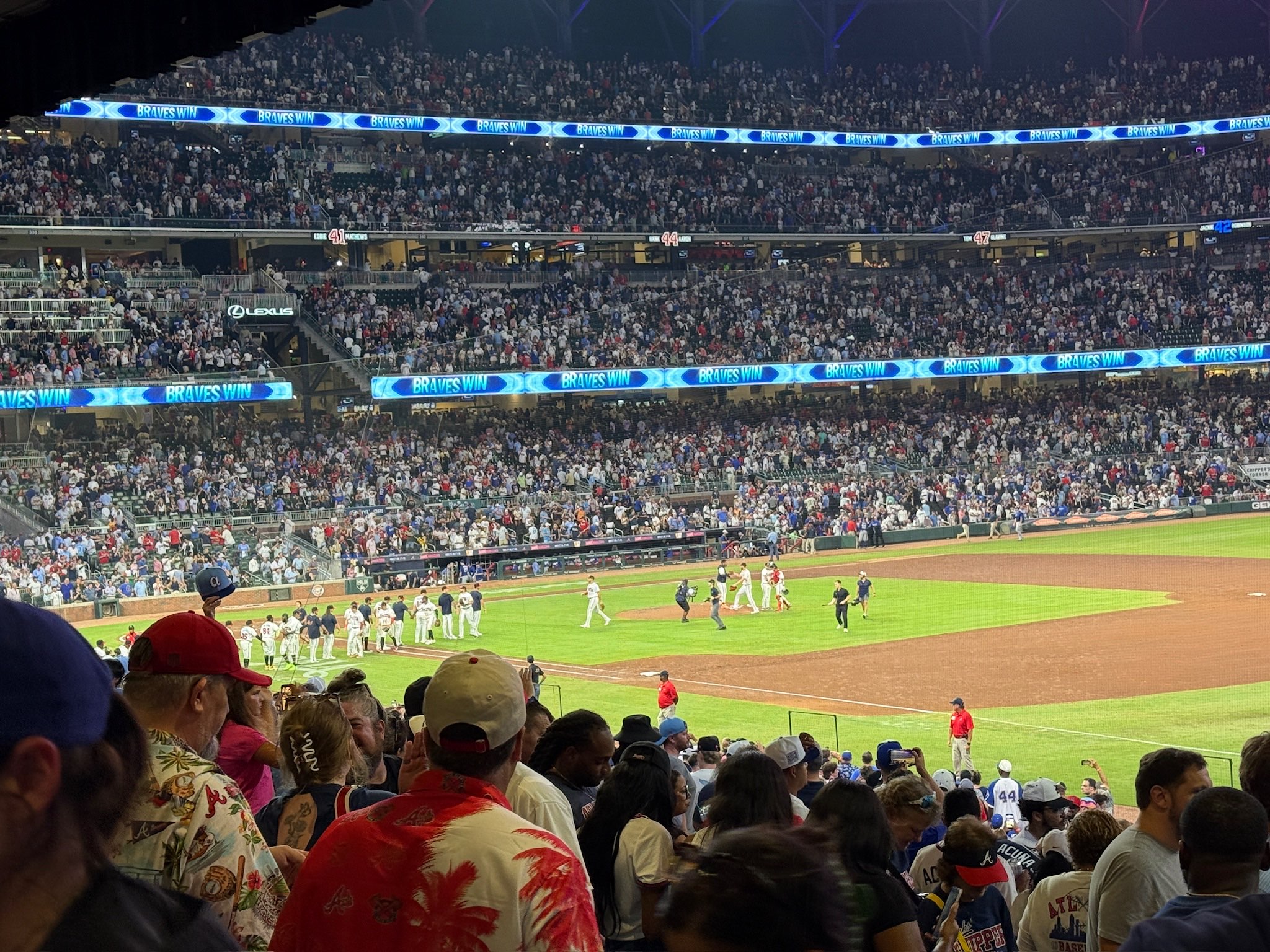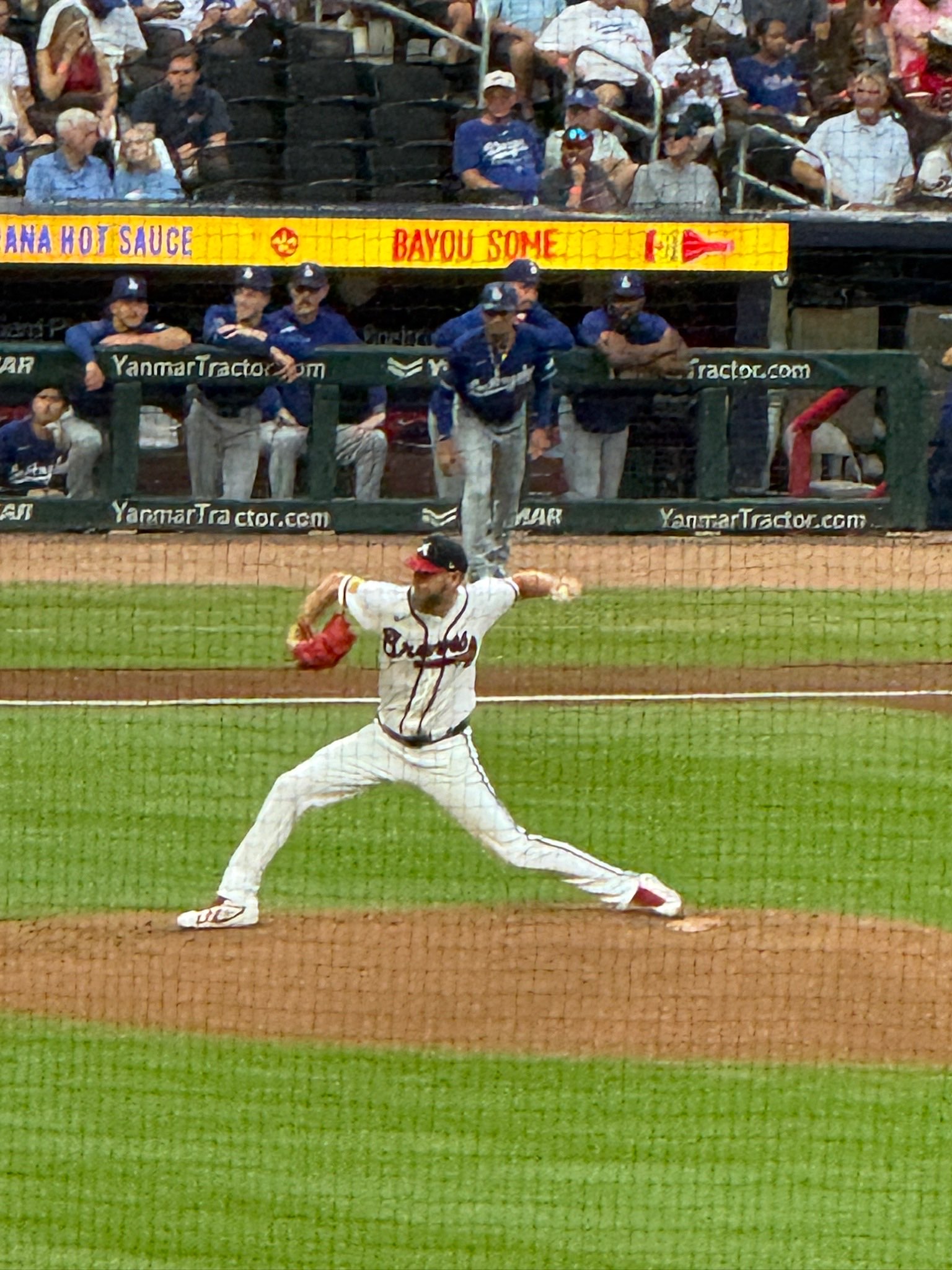
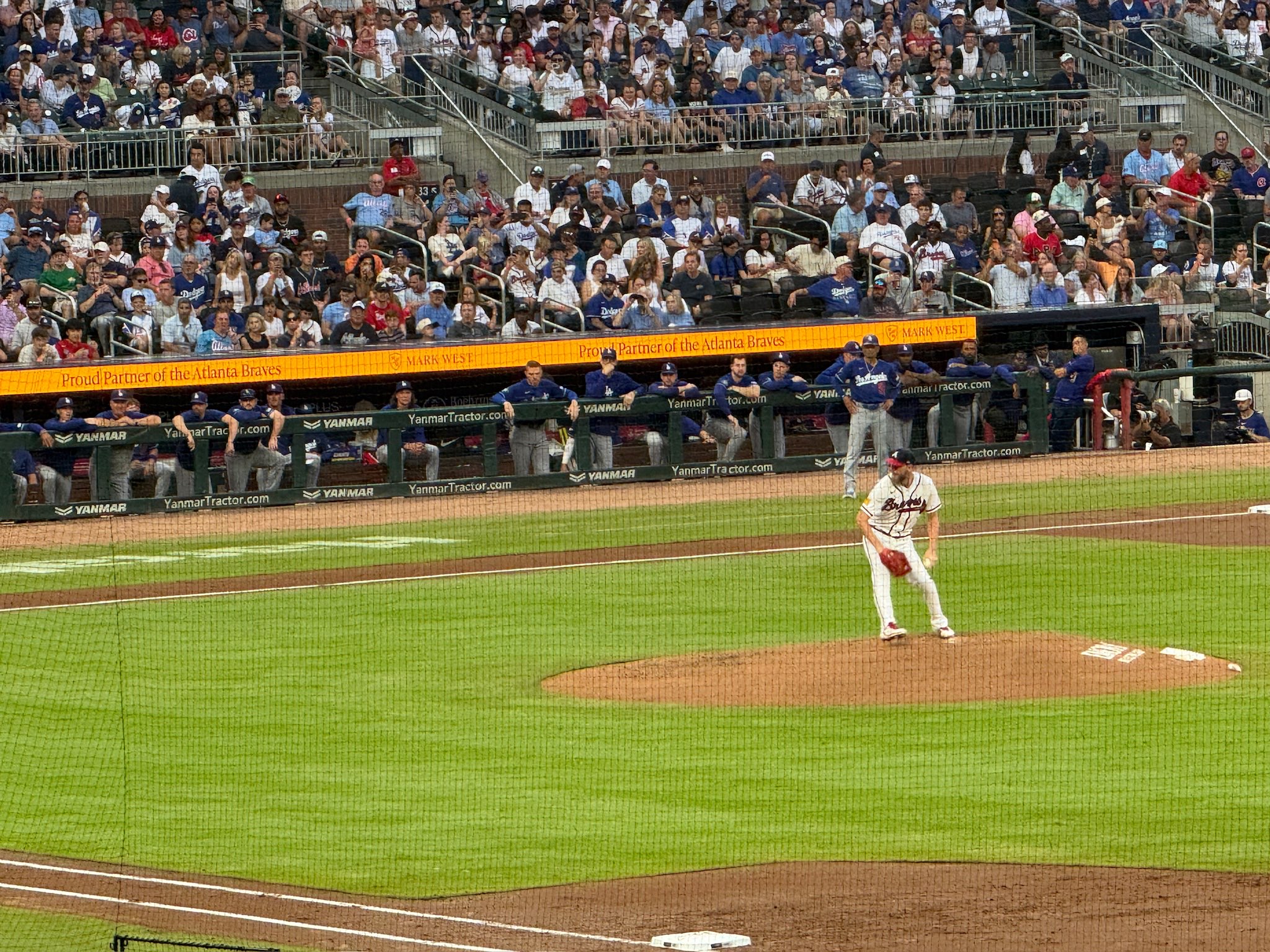
When I got tickets to see the Los Angeles Dodgers play against the Atlanta Braves on , at the latter’s home field of Truist Park, I hoped merely to see a good ball game. The Braves and Dodgers are my two favorite baseball teams, but at the time, the Braves were coming off a disappointing 2024 and an abysmal 2025 that certainly gave off the appearance of being a rebuild. Of course, the Dodgers were the defending back-to-back World Series winners, so I figured at least I’d see great performances from them.
I needn’t have worried: the Braves turned out to be one of Major League Baseball’s best teams in 2026 (they’d just been incredibly unlucky with injuries in 2025), so I became increasingly optimistic that I’d see great performances from both teams. Once the starting pitchers were announced – 2025 World Series MVP for the Dodgers, 2024 Cy Young Award winner for the Braves – I began to hope to see one of 2026’s best pitchers’ duels. I expected neither team to score more than two runs, and given both starters’ tendency to go deep into games, I began to hope I might even see a complete game from one or both of them. (I wasn’t so greedy as to tempt the baseball gods by hoping for a complete-game shutout.)
That’s exactly what I saw, though, and that’s only the start of it. I’ve attended hundreds of baseball games in my time. This was by far the best of them. It was also undoubtedly one of 2026’s best regular-season games, and it capped off one of its best regular-season series. The Braves took all three games by one-run margins, but all three were substantially different.
This game’s only run came from the very first pitch Yamamoto threw: Braves catcher knocked it out of the park. This isn’t unusual for Yamamoto: he has a tendency to give up leadoff bombs, then lock in for the rest of the game. Game 2 of 2025’s National League Championship Series is perhaps the best example of this: Milwaukee Brewers right fielder hit a leadoff tank off Yamamoto, who then threw a complete game without allowing another run. The Dodgers won 5-1 and went on to sweep the series.
Of course, Yamamoto didn’t get the same kind of run support here. He was nails, though: he threw 105 pitches across 6⅓ innings without giving up another run, struck out eight batters, walked only one, and allowed only four hits. He’d have been assured a victory against a lesser pitcher.
Baldwin’s leadoff home run was quite unusual. Since 1900, only 33 players have hit leadoff home runs in 1-0 victories. Baldwin is the first Braves player and first catcher ever to do so in that time.
I may have buried the lede on Chris Sale. He’s my second cousin. As a result, I’d resolved before the game to root for the Braves as long as Sale was on the mound and root merely to see a good ball game after he left.
Which he didn’t. In 109 pitches, he threw the ninth of eleven complete-game shutouts by any pitcher in 2026, struck out eleven batters, and allowed only five hits and no bases on balls (although he did hit two batters, which is hardly an unusual occurrence for him: he leads MLB in hit-by-pitches during the years he’s been active).
80 (73.4%) of Sale’s pitches were strikes. He threw a 100.1 mph fastball to Shohei Ohtani in the third inning (his fastest pitch since he threw 100.3 mph on 2018-07-16 and his seventh-fastest ever) and proceeded to strike Ohtani out on a 99.6 mph heater (also his fastest strikeout pitch since 2018 and his seventh-fastest ever). On the final pitch of the game, he struck out Alex Call on a 99 mph heater. In short, it was a career game for him – perhaps the game of his career.
Just in case anyone thinks I’m only a Braves fan because my second cousin pitches for them: I was born in Atlanta in 1983, and I still, to this very day, feel about 1991 how Toronto Blue Jays fans must feel about 2025. Yes, greatest pitcher’s duel in World Series history; yes, Jack Morris threw the game of his career in the highest-pressure environment possible. I’ve heard all the arguments. I’m still not over it. Even replays of it still hurt.
I also haven’t forgiven the Blue Jays for ’92 or the Phillies for, well, anything. I begrudgingly respect the current Blue Jays team, and especially its manager John Schneider, who seems like an extraordinarily classy and gracious human being. And I have complicated feelings about Don Mattingly being the Phillies’ manager this year – I don’t even know any Red Sox fans who dislike Donnie Baseball. But I can only find it in myself to root for the Blue Jays when they’re playing the Phillies, and I can only find it in myself to root for the Phillies when… well, if it ever happens, I’ll write an addendum to this section explaining when, how, and why.
(The Mets are too bad this year to be worth hating. If anything, I kind of admire them for single-handedly proving that throwing lots of money at players is insufficient to win baseball games, just as I admire the Rays and, also begrudgingly, the Brewers for proving that small-market teams can win their divisions, make deep playoff runs, and even have the best record in baseball.)
On his uptick in velocity against Ohtani, Sale said in an interview on The Pat McAfee Show the following day:
“I dare you to go throw a get-me-over fastball to Shohei. He’d probably hit that thing to the freaking Comcast building. So yeah, I think the game will dictate and tell you when it’s time to bear down and dig in a little bit, and I think given the circumstances, when you have a generational guy like he is – because let’s face it, he’s the gold standard guy right now of what it is to be just an ultimate baseball player, right? He’s doing things no one’s ever seen – and you get in those situations, and it’s a tight game.
“You talk about atmosphere and adrenaline. Adrenaline is dictated by moments and energy in the crowd, and if you’ve got 3,000 fans there that aren’t really paying attention to the game, the adrenaline is not going to be the same as last night. You’ve got a packed house, our fans are going crazy – you can feel that. You might not see it or hear it or notice it, but there’s a certain feeling. I’m sure you know what I’m talking about, but there’s certain times in where you’ve got to step up.”
He’s not wrong, which makes it even more impressive that he struck out Ohtani twice. Admittedly, Ohtani hasn’t quite been himself since roughly the All-Star Break, but his first half of the season may have been the best half-season we’ve ever seen from anyone. As of June 24, 81 games into the season, he was hitting .293/.414/.552, with a league-leading .966 OPS and 169 OPS+, and he’d pitched to a 1.47 ERA, 277 ERA+, 2.66 FIP, and 0.882 WHIP in 79⅔ IP, leaving him a meager 1⅓ IP from qualifying for the ERA title; he’d have been a close second in several of those stats if he had.
(For those unfamiliar with ERA+, a 277 ERA+ is 177% better than league average. That’s a video game number.)
More broadly, Chris is, unsurprisingly, entirely correct: no one’s done anything like what Ohtani’s doing since integration (1947-present) as long as he has. (Honor lūdī, a book I wrote last year, explains this in far more detail. Its title is Latin for Honor of the Game and The Game of Honor; the ambiguity is deliberate.) Several two-way players are immortalized in Cooperstown, but they all either:
As much as people compare Ohtani to Ruth, the Bambino wasn’t facing 100 mph gas, and he was only truly a two-way player for two years. Shohei has already done it full-time for three full seasons (2021-2023) and parts of three more (2018, 2025-2026). Moreover, the Sultan of Swat never played in an integrated league.
To be fair, Ruth’s , while a limited sample size, imply integration might not have damaged his pitching or hitting any more than it damaged Ted Williams’ hitting. But we can’t know that. In Honor lūdī, I explain how and why segregation and wars ⟨aaronfreed
To summarize, during World War II, with so many great players serving in the war, the standard deviation in hitting and pitching statistics sharply increased. With demand for skilled new players outstripping the supply, a replacement player’s skill floor decreased, improving the most skilled hitters and pitchers’ statistics. Segregation caused exactly the same issue: since not all MLB or Negro League hitters or pichers would’ve been good enough to play in an integrated MLB, the best hitters and pitchers in both MLB and the Negro Leagues had better stats than they’d have had if they’d faced only players who’d have played in an integrated MLB.
Thus, pre- and post-integration stats can’t always be compared, even when players played in exhibition games like those Ruth played in: it’s not a given that all their opponents would’ve played in an integrated MLB. League-adjusted stats like wRC+, OPS+, and ERA+ are better comparisons between pre- and post-integration stats than standard OPS and ERA, but even the league-adjusted stats have caveats.
Thus, Tony Gwynn’s .394 average in 1994 is arguably even more impressive than ’s .466 in 1943. I view Gibson as ⟨aaronfreed
To explain more concretely: Josh Gibson and Walter Johnson never faced each other in MLB. This improved both Gibson’s stats (he never hit against the all-time leader in complete-game shutouts) and Johnson’s (he never pitched against the all-time leader in batting average, slugging percentage, OPS, OPS+, wOBA, and wRC+).
I don’t even consider Ruth the best historical comparison for Ohtani. Sure, Ohtani has Ruth’s slug, but was more of a strikeout pitcher, threw harder, and stole more bases than Ruth. Here’s the clincher, though: the complete list of players with at least 500 IP and 1000 PA and a career OPS+ and ERA+ of at least 150.
| The 150/150 Club (as of 2026-10-11) | |||||
| Player | Career | IP | PA | ERA+ | OPS+ |
|---|---|---|---|---|---|
| Bullet Rogan | 1915–1938 | 1475⅔ | 2326 | 157 | 150 |
| Shōhei Ohtani | 2018– | 614⅓ | 4947 | 150 | 158 |
(Ruth, while himself an excellent pitcher, only had a career ERA+ of 122. He was nails in the postseason, though: his postseason streak of 29 scoreless innings [1916-10-09 to 1918-09-09] is the third-longest in history, behind only ’s 33 [1960-10-08 to 1962-10-04], and ’s 33⅓ [1998-09-29 to 2000-10-03].)
It’s especially noteworthy that Ohtani is the only two-way player to perform as strongly as he has in both roles since integration. In fact, he’s really the only person to have performed at this level as a two-way player in any form more than briefly (e.g., , an unusually hard-hitting pitcher, played 96 innings as an outfielder from 2018 to 2019). Arguably, since integration, the only players besides Ohtani who’ve done both roles even competently at any point in their careers, simultaneously or not, are (active 1941-1954), (active 1996-2004), (active 1999-2013), and Lorenzen (active 2015-present). (Honor lūdī has a ⟨aaronfreed
And yes, pitchers hit for themselves before the designated hitter rule. I began watching the Braves in the ’90s, so I miss this as much as anyone; many pitchers (e.g., , , , , , , , ) were good to great hitters, and I think there’s truth to the argument that pitchers benefit from understanding what hitters experience.
But pitchers weren’t in the lineup every game. Some were good enough to be used often as pinch-hitters (in fact, pitcher held the all-time record for most pinch-hits from 1933 to 1965). But even if they pinch-hit, they were typically only used for that one at-bat, and they were rarely used every game.
Thus, Ohtani’s career is unprecedented post-integration, and he’s doing things no one’s ever seen.
When Braves broadcaster Wiley Ballard asked Sale how he threw a 99 mph fastball for his 109th and final pitch of the game, Sale had a perfect answer: With my arm.
That’s Chris Sale for you: his velocity may rival that of many other modern starters, but he’s an old-school hurler of the sort we rarely see anymore.
Sale’s shutout at 37 years and 150 days of age also made him the oldest pitcher to throw a complete-game shutout with at least ten strikeouts and no bases on balls since Sale’s childhood idol , ironically enough, shut out the Braves on May 18, 2004, at age 40 years, 190 days.
MLB reporter Sarah Langs notes on Bluesky that only Sale’s age or older had accomplished the feat since at least 1900, and two of them were Johnson (he also did it in 2001). The other four were (1989), (1982), (1913), and (1905).
Langs also notes that Sale has , tying him with for the sixth-most such games since the pitcher’s mound acquired its current distance (60 ft, 6 in) in 1893: only Johnson (36), (31), (27), (27), and (24) had more. (He took on September 23.)
Langs adds that ) career 10+ strikeout games rank seventh since 1893, behind Ryan (215), Johnson (212), Scherzer (114), Clemens (110), (108), and (97). He’s the in the last forty years, behind (38 years, 37 days), Smoltz (38 years, 335 days), and (44 years, 19 days), and he’s to throw 100 mph or faster at age 37 or older in the pitch-tracking era (2008-present), alongside .
Sale finished the season with exactly 200 strikeouts. This was his ninth season with at least 200 Ks, which ties him with Scherzer, Verlander, Pedro Martínez, and for , behind only Ryan (15), Johnson (13), Clemens (12), and (10).
(Notice how many Hall of Famers have appeared in these lists?)
The back half of Chris’ season was incredible. From July 16 (the All-Star Break) to September 6, he led MLB in FanGraphs WAR (2.8), BB/9 IP (0.69), HR/9 IP (0.17), and FIP (1.23). A 1.23 FIP is the sort of thing we normally only see from relievers – indeed, among relievers, only had a better FIP than that this year. While will probably win the NL Cy Young Award, Sale has effectively unseated as the runner-up and has likely made the race somewhat closer than anyone expected it to be.
For the entire season, Chris wound up with:
From 2024 to 2026, he has:
He is the all-time leader in career strikeouts per base on balls with 5.36, and his 6.45 ratio in 2026 led MLB. His 144 career ERA+ also leads active players with at least 1,000 IP.
In short, if Chris Sale retired today, he’d be a Hall of Famer, and probably a first-ballot Hall of Famer at that. The only lingering question is how much of the vote he’ll get when he does retire.
To be clear, I’m certain he’ll continue pitching for at least another two seasons, because a certain trait runs in our family – call it perseverance or, if you like, call it stubbornness; perhaps they’re the same thing. Chris finished the 2026 season with 2,779 career strikeouts, leaving him 221 away from 3,000. When we get within striking distance of a milestone as monumental as 3,000 strikeouts, we keep going until we reach it.
Only 20 pitchers have reached that milestone. Of them, Clayton Kershaw will be inducted into Cooperstown in 2031, Justin Verlander in 2032, and Max Scherzer five years after his retirement (these aren’t predictions; they’re simple statements of fact), and all but two of the others already have been. Only four members of the club are lefties: Randy Johnson, Steve Carlton, Clayton Kershaw, and CC Sabathia.
Chris Sale will be the 3,000-strikeout club’s twenty-first member and fifth lefty. This, too, is a statement of fact. In his three seasons with the Braves, Chris Sale has achieved a mean of 196.7 strikeouts per year. Moreover, he may be its last. He’s third place on MLB’s active strikeout leaders list behind Verlander and Scherzer. I intend no shade on any of the following pitchers, but I’m less convinced that any of them will make it than that Sale will:
9th-place (age 38 as of June 19, 1988) has 2,052. Only awful injury luck has kept him from passing 3,000 himself, and while it’s a long shot, he might yet: he struck out 201 batters this year.
His Hall of Fame case will also be a fascinating bellwether of how the BBWAA will treat future starting pitchers. He won’t have a lot of the counting stats they love so much. But, in his favor:
All-time career WHIP leaders list:
Were it solely up to me, he’d be a first-ballot inductee.
(Unrelatedly, I also wonder if he could’ve made it in MLB as a two-way player, considering he was no slouch as a shortstop in college; indeed, he once went yard against Sale, to which Sale himself said, Don’t let him lie to you: that ball was crushed. Oh my god, crushed. And he did it batting lefty.
[Sale eventually exacted his revenge by surpassing deGrom‘s career ERA+ total.])
Of the remaining people on the list, I think the likeliest to make a serious run at 3,000 is 21st-place (age 30 as of December 28, 2025), with 1,452 Ks. Cease leads the American League in SO/9 IP this year, with 12.7, and struck out a total of 239 batters. He’ll probably slow down somewhat as he ages, but if anything, he’s ramping up; his previous season best was 227. Although is considered the AL Cy Young favorite, Cease is providing his stiffest competition.
The inevitable question of how younger pitchers like Misiorowski may fare depends on their health.
Pitchers like Misiorowski, Yamamoto, and Skenes could make serious runs at 3,000 if they stay healthy and if their managers use them enough to give them a serious chance. The issue is that, on the whole, pitchers aren’t going as deep into games, and they’re getting injured more often, so the days of pitchers seeing enough playing time to even reach the milestone may be over.
Take (age 33 as of December 4, 2025), the all-time leader in K/9 IP, who’s in 19th place on the active strikeout leaders list with 1,495. Snell might’ve made a serious run at 3,000 were the Dodgers not so focused on keeping him rested for the postseason – he’s averaged 52 IP per season in two years with them. He was lights-out this year especially, pitching to a 1.90 ERA, 224 ERA+, 1.72 FIP, and 1.102 WHIP, but that was in only 42⅔ IP.
(Yamamoto may actually be the most interesting outlier here, due to his unusual training retinue focused less on strength than on flexibility and endurance. This attracted some attention after his 2025 World Series MVP, but it’s still unclear how much it’ll catch on. Thus far, he’s yet to be sidelined for more than a few months by injuries.)
For a long time, people cited , , , and as their generation’s four starting pitchers who were certain to be enshrined in Cooperstown. At this point, it’s hard to imagine a defensible argument against adding to their ranks. In many ways, he is the last of a dying breed.
Sale mentioned in an interview with Pat McAfee the day after the game that he’d played catch with his sons earlier that day. I believe him. But also, excuse me, literally how? You hit 100 mph last night, you threw a 109-pitch shutout against the defending back-to-back World Series champions the night before, you’re 37 years old, and you’re still good to play catch? I’d have been too sore to get out of bed. His endurance must rival Yamamoto’s.
(To be clear, I absolutely believe him. For those unaware, Yamamoto earned his World Series MVP partly by closing out Game 7 with 2⅔ shutout innings after having thrown six innings of one-run ball in Game 6 the night prior. And just for good measure, he’d thrown one-run complete games in Game 2 of both the World Series and the NLCS, and he was warming up in the bullpen in Game 3 when former Braves legend Freddie Freeman hit a walkoff home run in the eighteenth inning. Some guys are just built different.)
(Watch Foolish Baseball’s video “” ⟨youtu
When Pat asked Chris about being an elder statesman, he was remarkably humble and spent almost his entire answer discussing his own mentors:
“There’s this certain brotherhood, this certain umbrella that’s over all of us. I just think back when I was a kid, and I remember at my first All-Star Game, walking in there, and I was in the corner with pitchers like and and and , and I remember just being like, ‘Man, these are the guys I grew up watching, and now I’m in the same locker room, just sitting there, chopping it up, talking baseball.’ I think that’s a very important aspect of the game that shouldn’t be lost, just little things that get passed down from generation to generation. I’m doing things that I learned from the guys before me. And I hope maybe there’s something that I do or something that I say that resonates with somebody, and they can use it, and then they pass it on. That’s a cool, cool thing.
“Like was at the game last night, and he was my first catcher in the big leagues, and he was like, ‘Man, I’m just glad you made it quick.’ And I said, ‘You know, that’s something I learned from .’ And I’m hoping maybe in ten years from now, there’s a guy that learns that from me, but I learned it from him, and then you’ve gone thirty or forty years down the line, and Mark Buehrle is still a name getting thrown around because of something I did that’s something he taught me, and something someone taught him before.
“So this game can be special that way. And again, like I said, it’s a certain brotherhood that you just try to keep connected. But once those lights flick on, it’s go time.”
Thirty or forty years
may sound hyperbolic, but I can assure you this sort of influence can last much longer. For instance, how many hitters are still influenced by , , or ’ approaches? used to carry Williams’ The Science of Hitting with him wherever he went (and may still, for all I know).
I could just drop the mic there, but I have another example that may be even more compelling. The Cleveland Guardians’ , one of modern baseball’s best contact hitters, has said he models his entire hitting approach on that of Hall of Famer , one of the greatest contact hitters in history.
Now, Joe Sewell may not be a household name outside Cleveland, but he was a career .312/.391/.413 hitter who struck out a whopping 114 times and scored 1,141 runs in 8,333 plate appearances. That’s right: ten runs per K.
Sewell’s 167.7 at-bats per K in 1932 are a season record as unbreakable as ’s .492 average (1871), ’s 20.2 rWAR (1883), ’s 60 wins (1884), and ’s 513 strikeouts (1886). Likewise, his 62.6 at-bats per K are a career record as unbreakable as Cy Young’s 511 wins, Babe Ruth’s 182.6 rWAR, Josh Gibson’s .373 batting average, and Walter Johnson’s 110 shutouts.
Sewell never exceeded twenty Ks in a season; his last double-digit count was in his fifth. In his fourteen MLB seasons, he equalled or exceeded his K total that year in at least four other ways:
| Joe Sewell: Annoying opposing pitchers for fourteen years | ||||||||||
|---|---|---|---|---|---|---|---|---|---|---|
| Year | SO | BB | 2B | 3B | HR | R | RBI | HBP | rWAR | fWAR |
| 1920 | 4 | 9 | 4 | 14 | 12 | |||||
| 1921 | 17 | 80 | 36 | 101 | 93 | |||||
| 1922 | 20 | 73 | 28 | 80 | 83 | |||||
| 1923 | 12 | 98 | 41 | 98 | 109 | |||||
| 1924 | 13 | 67 | 45 | 99 | 106 | |||||
| 1925 | 4 | 64 | 37 | 7 | 78 | 98 | 4 | 5.3 | 4.8 | |
| 1926 | 6 | 65 | 41 | 91 | 84 | 8 | 6.0 | |||
| 1927 | 7 | 51 | 48 | 83 | 92 | 9 | ||||
| 1928 | 9 | 58 | 40 | 79 | 70 | |||||
| 1929 | 4 | 48 | 38 | 7 | 90 | 73 | 5 | 4.4 | ||
| 1930 | 3 | 41 | 17 | 6 | 44 | 48 | 7 | |||
| 1931 | 8 | 61 | 22 | 102 | 64 | 9 | ||||
| 1932 | 3 | 56 | 21 | 3 | 11 | 95 | 68 | 3 | ||
| 1933 | 4 | 71 | 18 | 87 | 54 | |||||
| ≥ | 14 | 14 | 3 | 2 | 14 | 14 | 7 | 3.0 | 1.0 | |
| > | 14 | 13 | 2 | 2 | 14 | 14 | 5 | 2.0 | 1.0 | |
Joe Sewell last played in MLB in 1933. Steven Kwan’s rookie year was 2022 – a full eighty-nine years later. How did Sewell’s influence survive so long? He became a highly successful coach after his playing career ended, and many players he coached themselves went on to become successful coaches… one of whom coached Kwan. Now, Kwan strikes out way more often than Sewell did, but Joe Sewell never had to face Chris Sale, Jacob Misiorowski, Cam Schlittler, or Dylan Cease. Kwan still walks more often than he strikes out, which in itself is rare.
A truly great player – which Mark Buerhle surely was, having accrued 59.0 rWAR and 51.5 fWAR across a 16-year career, with MLB’s 18th perfect game as the pièce de résistance – can have a legacy that survives centuries. That’s one of the things I most love about baseball.
Pat also mentioned that that no one else in MLB history had pulled off across their entire careers what Chris had done the previous night:
(Said lineup also included the prior year’s NLCS MVP [Ohtani] and three players who’d be first-ballot Hall of Famers if they retired tomorrow [again, Ohtani, Freeman, and Betts].)
Chris responded with far more grace and humility than I would’ve:
“They like to cherry-pick those, with the sun setting at a certain time south of the Mason-Dixon line with 46% humidity and elevation here and there. I mean, I do appreciate it. I do love the history of the game, but you can get down a rabbit hole chasing numbers sometimes.”
In a separate interview, he told The Athletic:
“I pride myself on going out there and giving my team a chance to win. Sometimes it’s good, sometimes it’s not. But I’m just thankful for the people that I have in my corner to help me get out to that mound. I’ve said it a lot, but this isn’t me just behind the scenes doing what I do to get out there. I’ve got a lot of people in my corner helping me out.…
“It was awesome. I definitely appreciate it. I’m thankful for it. But at the end of the day, it still counts as one win.”
I’m in awe of Chris Sale’s pitching, but it’s not just that. A team player needs to be able to lift others up (a rising tide lifts all boats, as they say) and to give credit where it is due. Chris does an exemplary job of both of those, and he clearly hasn’t let fame or success get to his head.
I often hear people claim American politics has come increasingly to resemble team sports. These people are saying they don’t understand team sports without saying they don’t understand team sports. When Chris came out for the ninth inning, and again after he completed the game, the entire stadium, Dodgers fans included, got to their feet in recognition of a monumental achievement.
This isn’t a unique occurrence – visiting pitchers routinely get standing ovations from home crowds for throwing no-hitters or perfect games, or even near-no-hitters. On , Yamamoto got a standing ovation at the Chicago White Sox’ Rate Field when he exited after ’ solo home run spoiled his 8⅓-inning no-hit bid. (Yamamoto still got the victory: the Dodgers won 7-1.)
Likewise, on , the Miami Marlins removed after seven perfect innings and were treated to a chorus of boos and “Shame” chants from the Oakland Sacramento Athletics of Las Vegas’ home crowd, despite their team being down 8-0 at the time. (The baseball gods clearly didn’t approve, either: the Fish would go on to win this game, but only by a 9-8 margin.)
Perhaps the most famous example, on , also involved the Marlins, but this time, it was their home crowd at loanDepot Park cheering an opponent’s accomplishments. Fully aware that they were witnessing history, the Marlins’ fans applauded each of Ohtani’s historic accomplishments – and there were many of them.
In short, team sports demonstrate levels of, well, sportsmanship and even honor rarely seen in modern politics.
I’m going to try to discuss politics as apolitically as I can. I’ve made my own stances abundantly clear elsewhere, but they’re irrelevant to this discussion. I have no political agenda in writing this; I intend instead to dispassionately address the state of politics itself.
This country is probably more divided than it’s been since the Civil War. As tempted as I might feel to cast blame for this, that would actively contribute to the problem: the supporters of those I blamed would simply react defensively, and then we’d be off to the races. The only winning move, to coin a phrase, is not to play.
I think part of the problem is a misconception of our own nature. We like to consider ourselves the heroes of our own stories. But heroes aren’t flawed – so we’re not flawed, right? We’re heroes.
But reality isn’t that simple. To fix our flaws, we must first accept them. Thus, thinking of ourselves as traditional heroes is counterproductive: at best, we’re antiheroes.
Another issue is that if we’re heroes, it follows that our opponents are villains. But that’s oversimplifying, too. Some might have malicious motives, but many, if not most, are ordinary people who simply have different beliefs and are just trying to get by. Ultimately, outside monsters like Hitler or Stalin, classifying specific people as good or bad strikes me as at best an oversimplification and at worst a way to avoid engaging directly with their ideas.
People are a mix of good and bad. To be sure, identifying destructive behaviors and even beliefs can be helpful, but too often, characterizing people as good or bad just shuts down our rational thought: “They’re bad people, so I don’t have to consider their arguments.” That’s not how it works. When we find ourselves discounting others’ views without thinking critically about them, we owe it both to them and to ourselves to ask why they believe what they believe, why we believe what we believe, and whether there’s any possibility of reconciliation.
(“Treat others how they wish to be treated” is also a far better ethical standard than “treat others how you wish to be treated.” I elaborate in more detail here.)
American politics has continually gotten more polarized since I became politically aware over a quarter-century ago. If we don’t stop arguing with each other and start listening to each other, I shudder to think where we’ll be as a society in another quarter-century.
The brilliant science-fiction writer Harlan Ellison’s many credits include the Star Trek episode “The City on the Edge of Forever” and the sci-fi horror short story and video game “I Have No Mouth and I Must Scream”. These accomplish the herculean feat of getting science-fiction fandom to agree on anything: all three works are near-universally considered flawless masterpieces.
He was also frequently an insufferable jerk who sometimes brought people to tears; his infamous humiliation of fellow science-fiction writer Connie Willis in front of her peers at a convention is just the tip of the iceberg.
But he was also capable of immense kindness and bravery. I’ll outsource this description to Babylon 5 creator J. Michael Straczynski, as his is much more eloquent than mine would ever be:
Harlan and his wife Susan had taken several of us out to dinner in downtown Los Angeles. Later, with Harlan at the wheel and me riding shotgun because he always made sure I had that seat due to my height, we were driving back through some of the sketchiest and most gang-run parts of town because a) this was the fastest route and b) Harlan was f***ing fearless. It was clear from the dealers and others eye-f***ing us as we drove past that we weren’t supposed to be there, and wherever we were going, we’d best just keep going there.
Then, on the right, we passed a homeless woman sitting by herself on the curb, one hand covering her face, the other on the shopping cart that held her few possessions. She wasn’t looking for a handout or asking for money. Just exhausted and tired and, though you could not see her face, clearly in tears. At the speed Harlan was driving, it was only a glance as we passed.
Harlan hit the brakes. Glanced in the rear and side mirrors. “Goddamnit,” he said, “she’s all alone.” He punched the steering wheel, then – an inner decision made – got out of the car and walked the half block down to her. We didn’t know what the hell to do any more than the guys watching from the shadows.
I popped the door enough to hear what was being said, and to be ready to jump in if anything went wrong.
“Are you okay?” he said. “Do you need anything? Can I do anything?”
She shook her head, but I could not make out her words.
“It’s gonna be okay,” he said. “You’ll be all right.”
Then, with an economy of motion, so no one else would see what he was doing, he reached into his jacket, fumbled one-handed with his wallet, and pulled out some bills. Then he carefully slipped the money into her hand, sheltering the move from view.
“Don’t let them see you have this, okay?” he said. “Go get something to eat. Maybe a place to stay for the night. You’re not alone.”
Then he straightened and came back to the car. He didn’t acknowledge it but when I glanced over at him I could see that his eyes were moist. He didn’t say anything else, and we continued north into the valley.
I know many fine people, good and caring and charitable. But I cannot think of anyone else who would have had the perception to see her, the compassion to stop for her, or the courage to walk out into a no-man’s land where he could have been shot and robbed to make sure she was all right.
That was my friend Harlan.
(Apologies for the censorship, but I’d like to keep this PG for reasons that should soon be obvious.)
One person can be callous and cruel one moment, compassionate and courageous the next. Defining them just by their worst moments is as disingenuous as defining them just by their best. As humans, every last one of us is flawed, and every last one of us is a work in progress. If we can’t acknowledge our opponents’ humanity, we become part of the problem ourselves.
Team sports can produce the sort of tribalism I’ve been discussing from its most diehard fans, but I’ve seen just as much, if not vastly more, of the opposite. Most often, fans of a given sport recognize rival teams’ fans and players as part of the same community, which I cannot say of politics.
(Yes, I recognize the irony of an Atlanta Braves fan discussing tribalism.)
For instance, Dodgers and Blue Jays fans were, with rare exceptions, extremely respectful to each other and their players during last year’s World Series, and I saw very few cases of Dodgers fans being sore winners after Game 7 – I saw many more openly commiserating with Blue Jays fans by acknowledging that, had their fortunes been reversed, they’d have been devastated. (And the few sore winners quickly got downvoted to oblivion.)
Similarly, Freddie Freeman got a few boos from Braves fans, but most received him quite warmly in recognition of his massive contribution to Atlanta’s victory in 2021. Tarik Skubal got a standing ovation when he returend to the Detroit Tigers’ Comerica Park as a Dodger on August 28. And so on.
In short, I wish American politics were more like team sports. If it were, maybe we’d start healing as a country.
“Family values” has been thrown around so much in contentious political contexts that its original meaning is in danger of being lost to history. I can think of nothing better to represent actual family values than an incredibly wholesome event from this exact game that I only saw later, since I wasn’t in a vantage point to see it live. In the ninth inning, when Chris came out to pitch, his second-eldest son was perhaps the first person in the entire stadium to rise to his feet, which indicates two things:
(Also, the announcers didn’t need to say he was Chris’ son. We all knew already.)
This implies Chris is raising his kids correctly. Which in turn implies that he was raised correctly.
Baseball holds a special place in American culture alongside mom and apple pie. It’s a reminder of all the many things we still have in common. And it feels right that the day after giving the best pitching performance I’ve ever witnessed in person, Chris Sale threw a game of catch with his sons. That tells me there may still be some hope for the future after all – and I can imagine no better epilogue to the greatest baseball game I’ve ever attended.
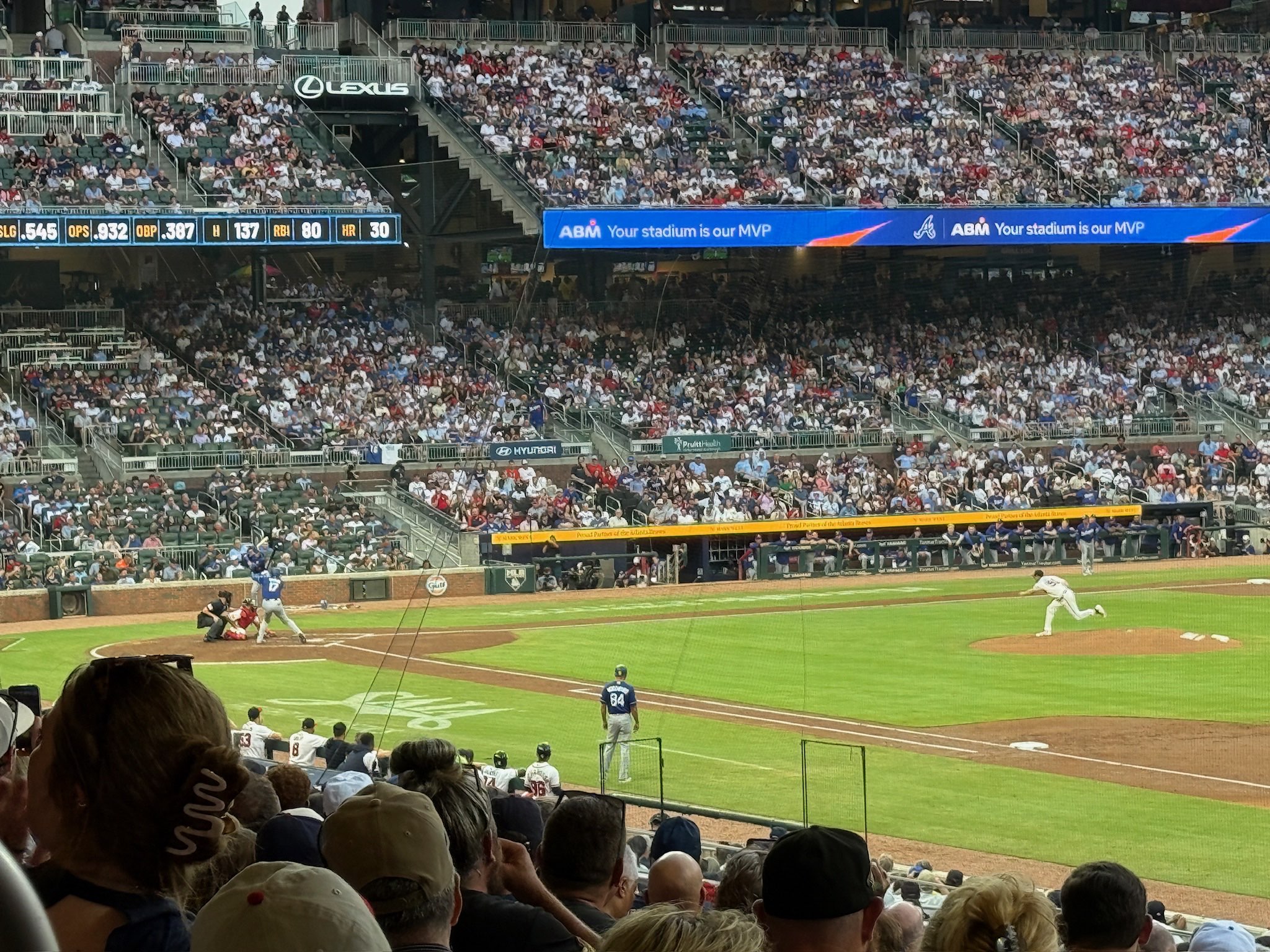
We weren’t really close enough to get the greatest photos possible, but my mom, Becky, still took some that are interesting enough to share. I did take one of what turned out to be Chris striking out Shohei in the fifth inning, but it was too blurry to be worth posting. (My phone can only zoom in 5x; my mom’s can zoom in 25x. As it turns out, that makes a huge difference.)
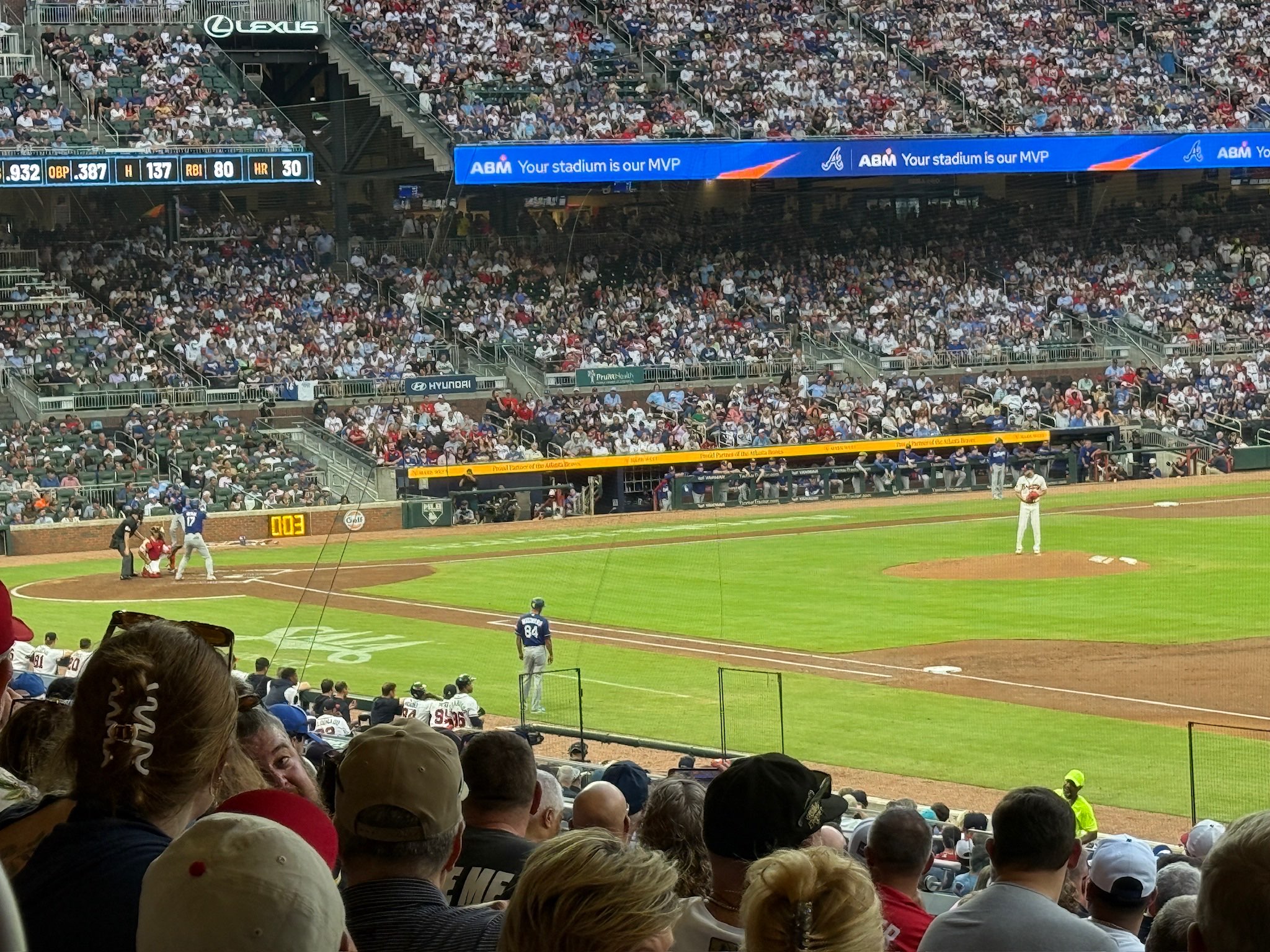
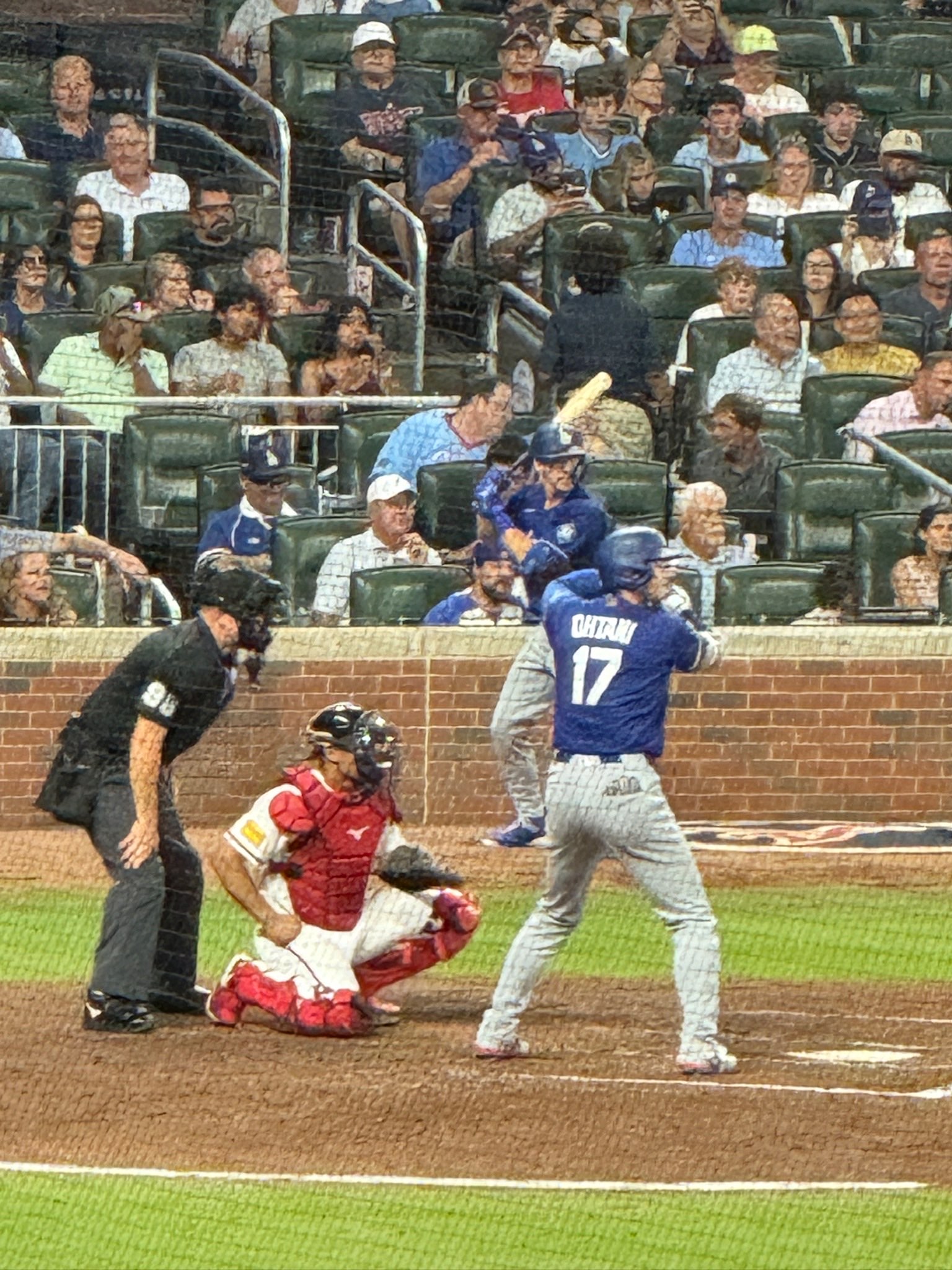
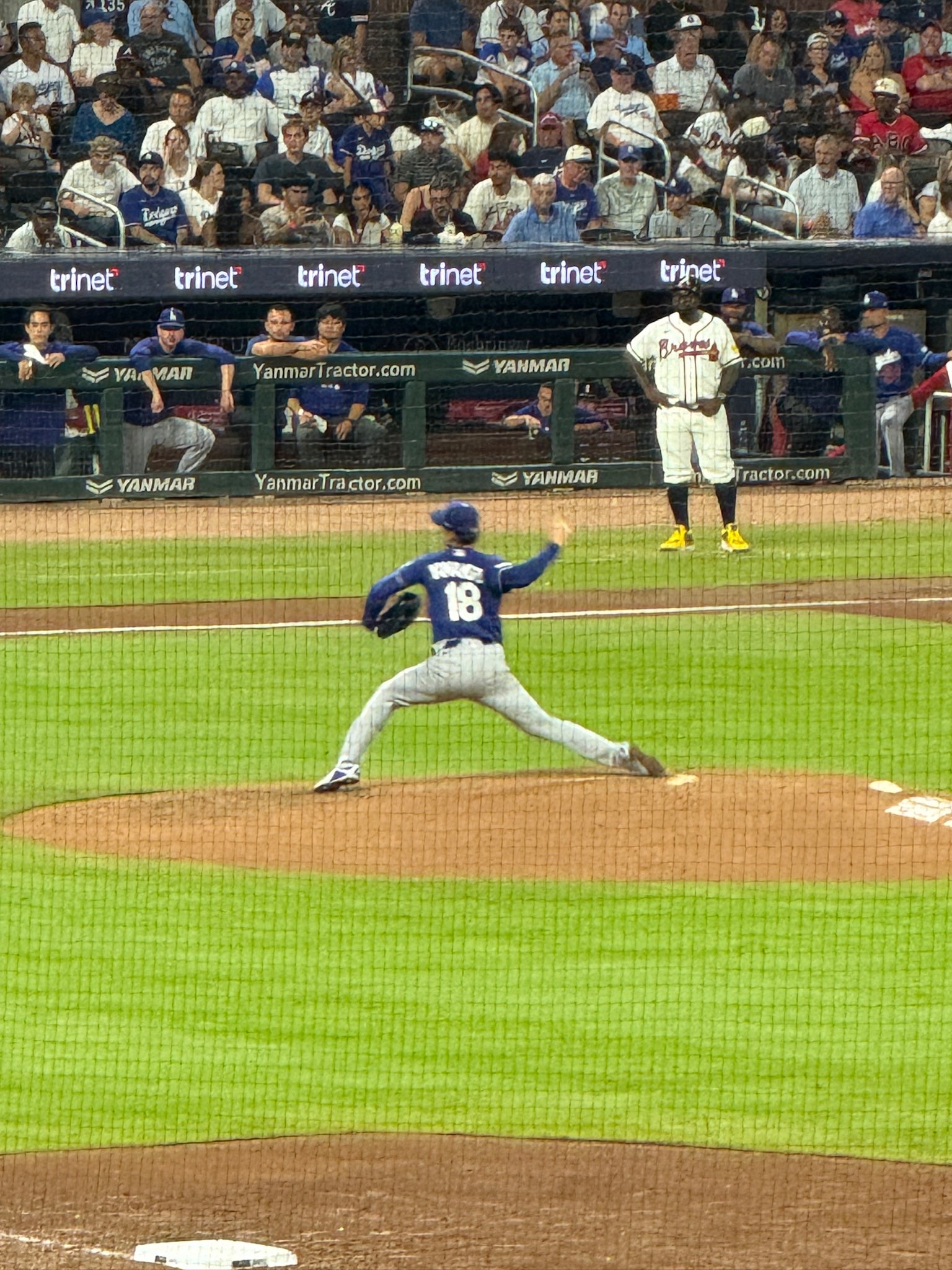
I’m not sure which at-bat this is, much less what pitch, but several of Chris’ most memorable pitches of the game were to Ohtani, who fouled off Chris’ fastest pitch of the night, a 100.5 mph fastball, and struck out twice.
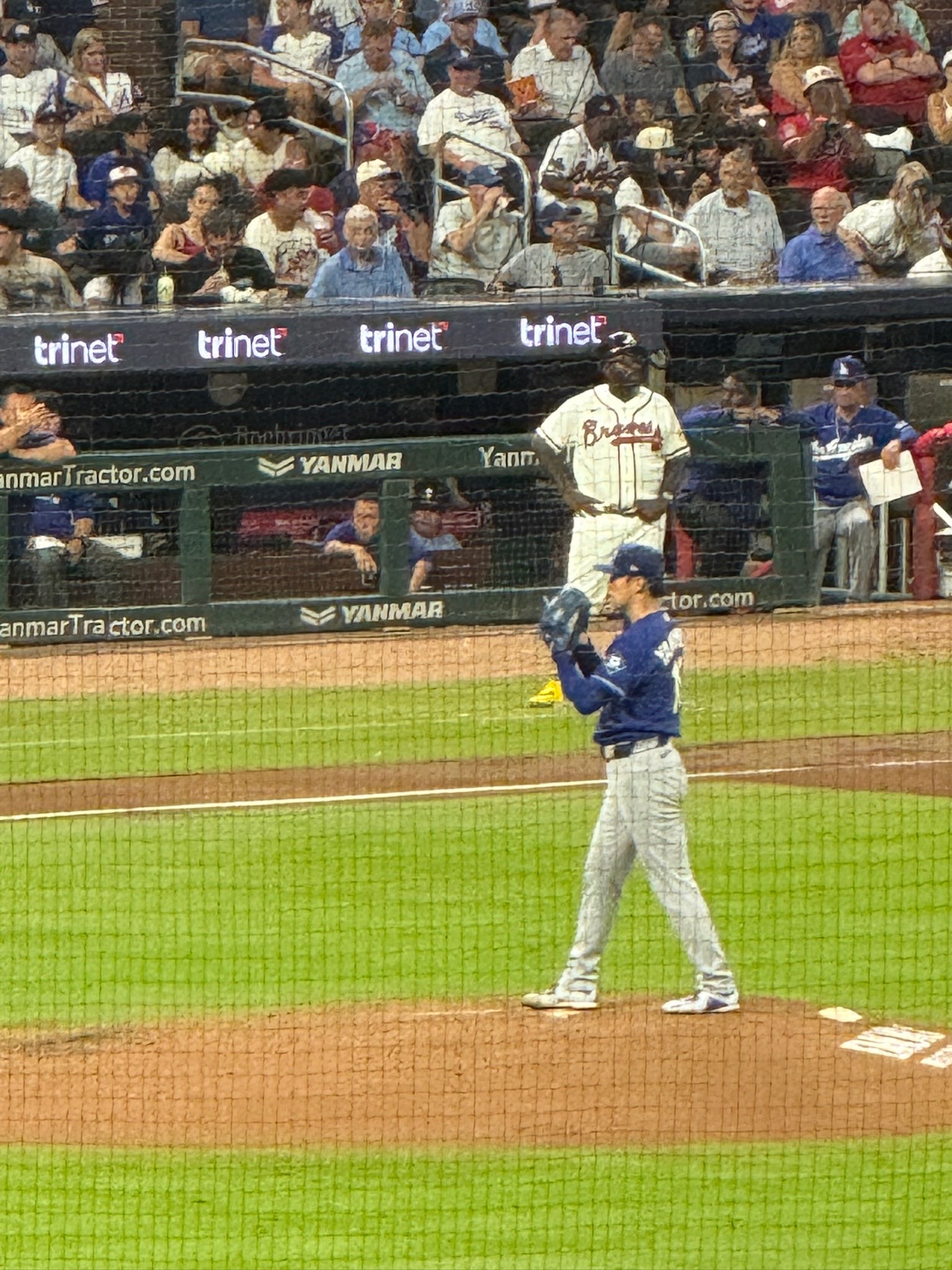
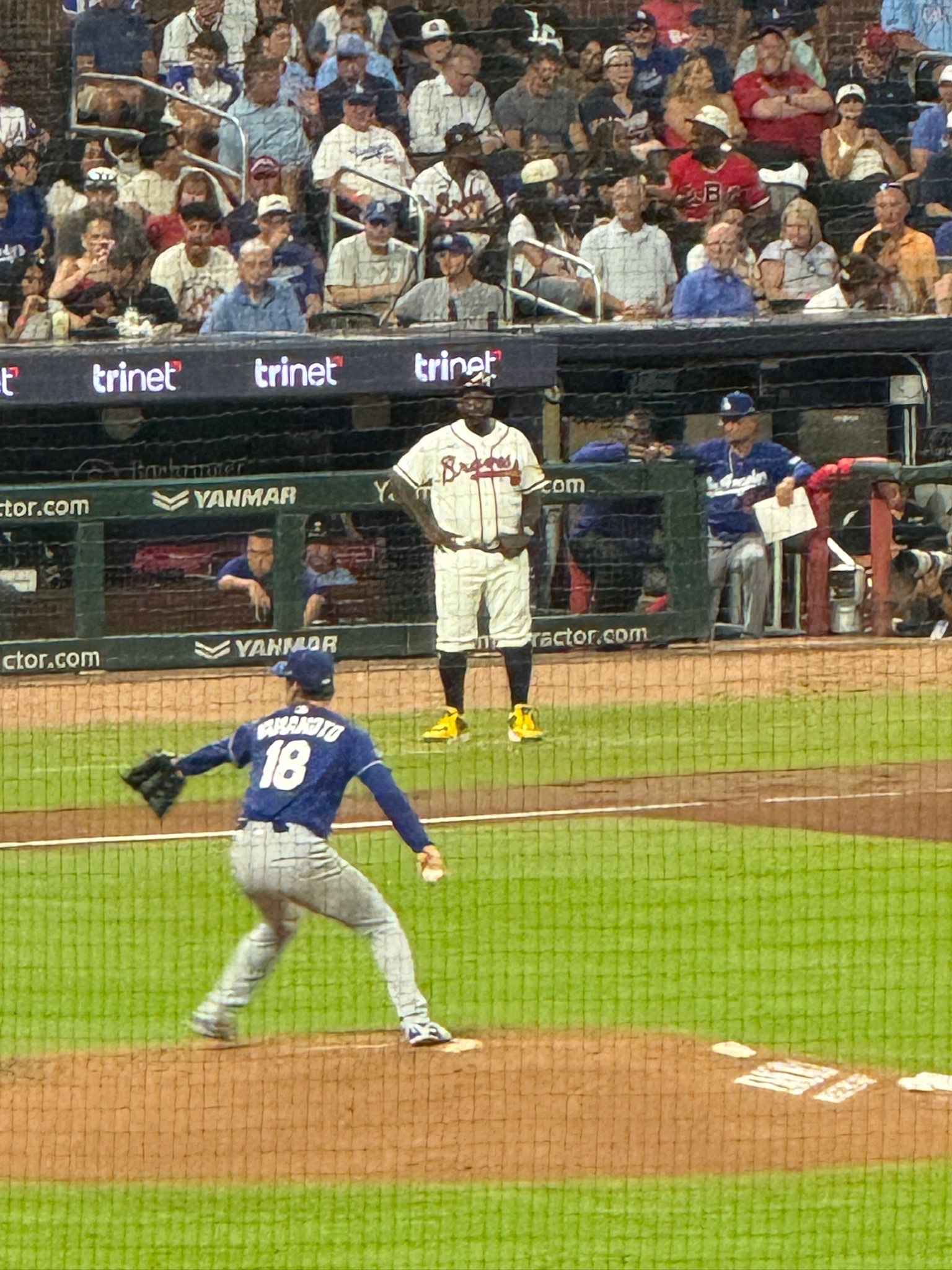
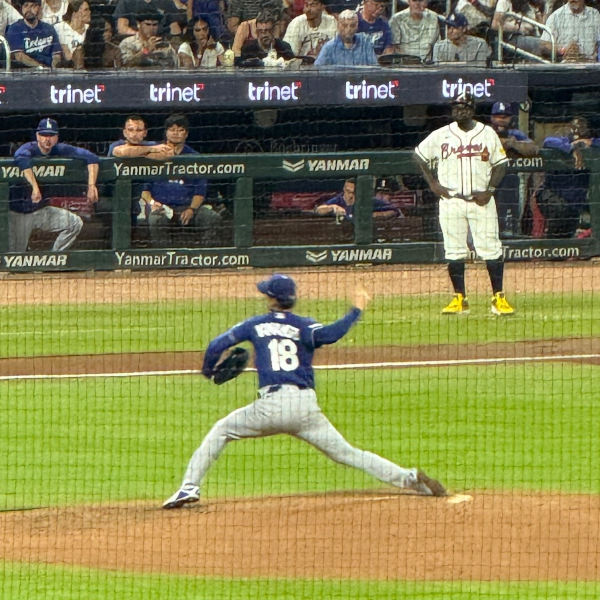
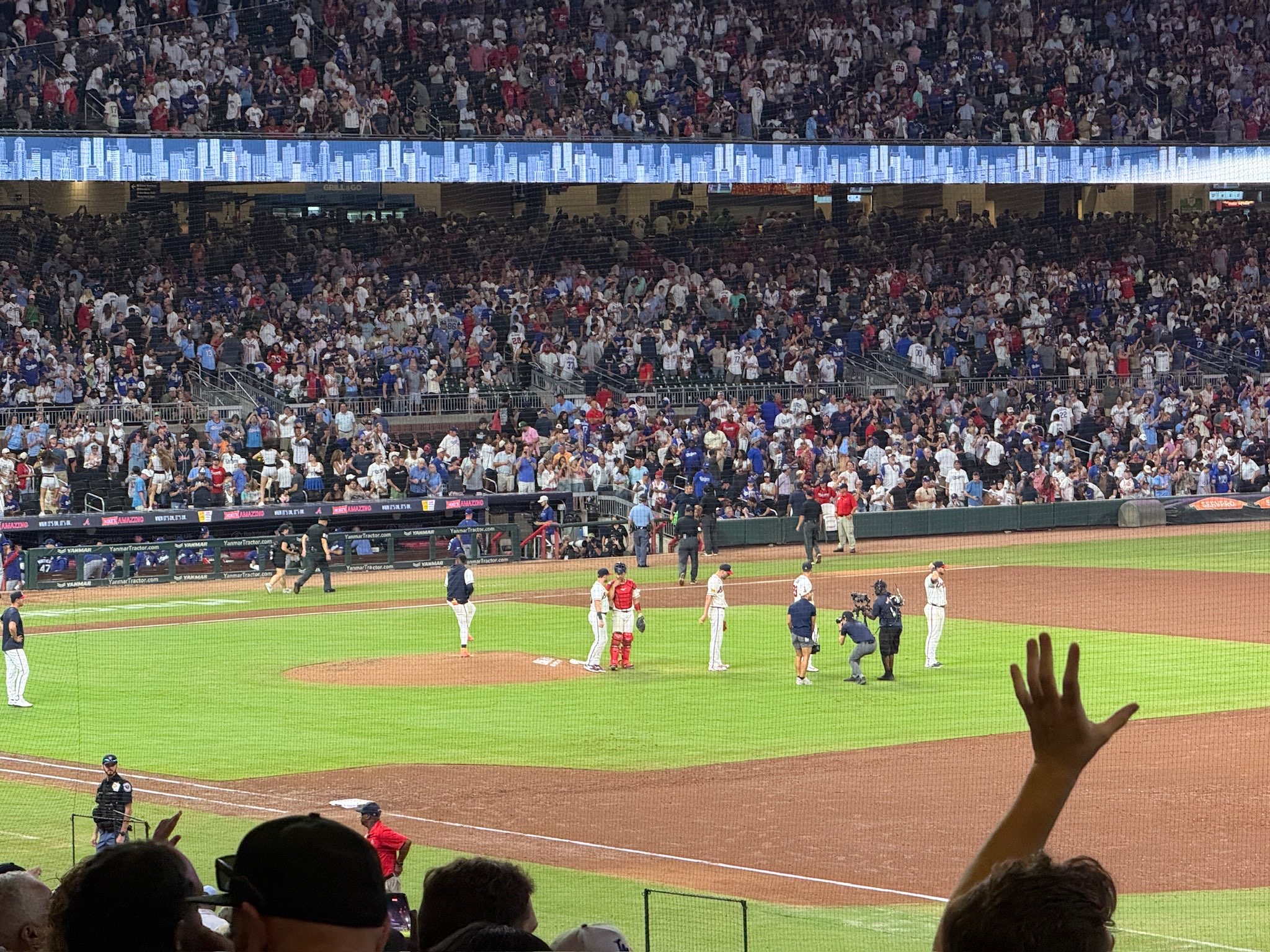
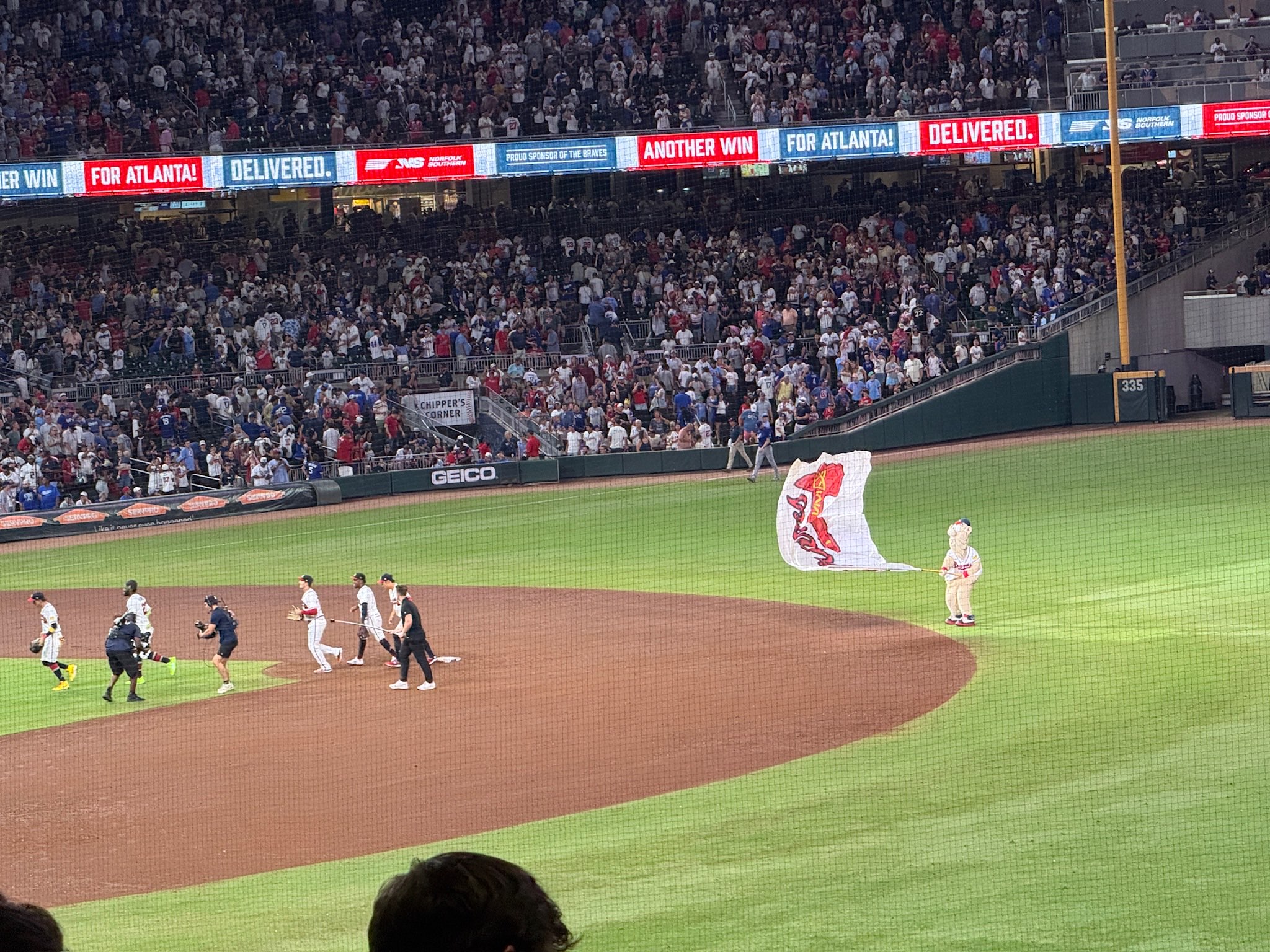
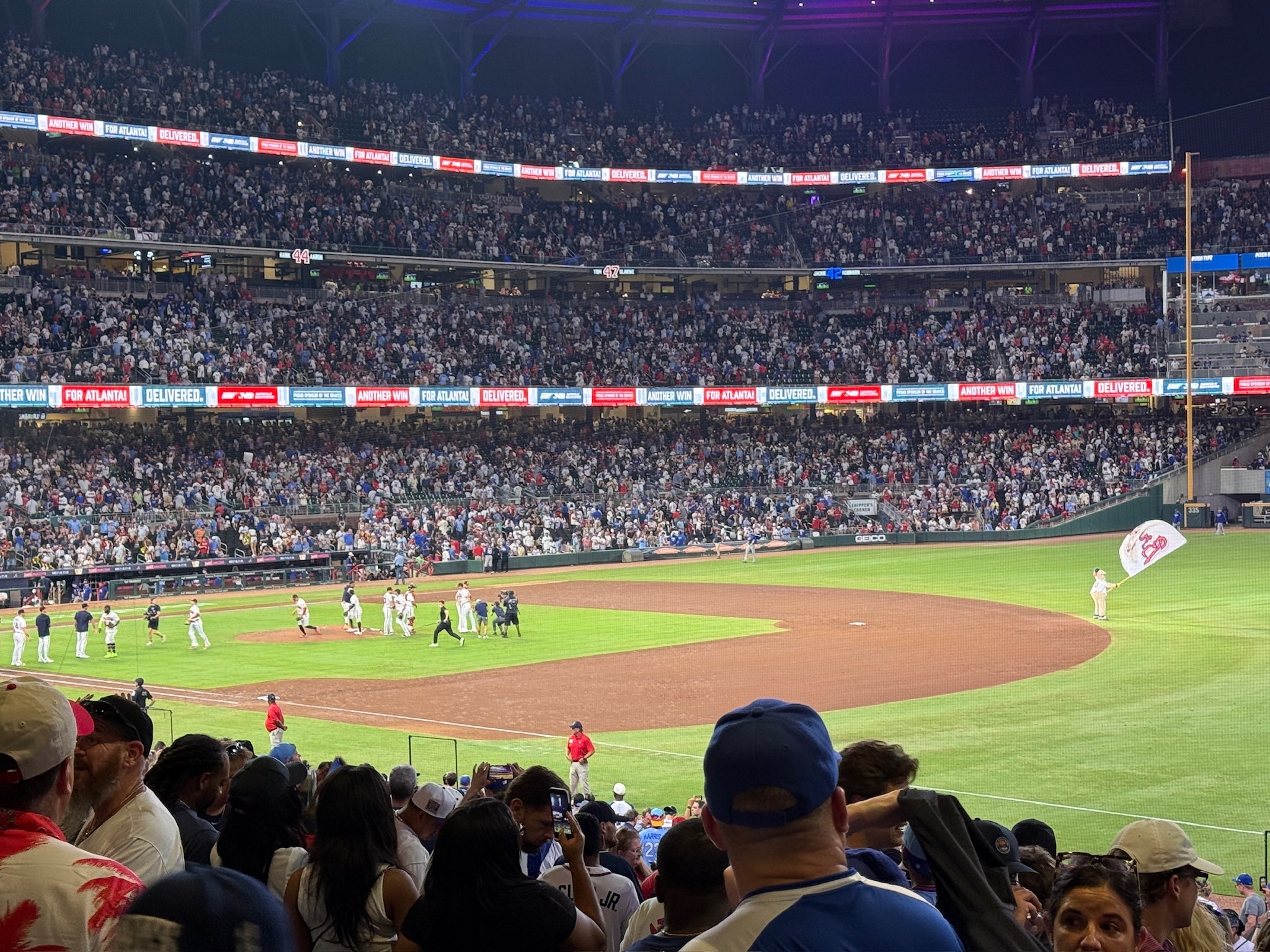
I wish I were surer of these photos’ context, but the first may show Chris’ postgame interview with Wiley Ballard. In the next, Braves mascot Blooper waves the team flag. (What a perfect baseball mascot name.) I think the last two are of Chris’ teammates congratulating him.
I wish to express my immense gratitude to the following people:
—Aaron Freed
Tallahassee, FL
September 2–10, 2026
rev. September 18 & 24, 2026
October 11–12, 2026